Evals
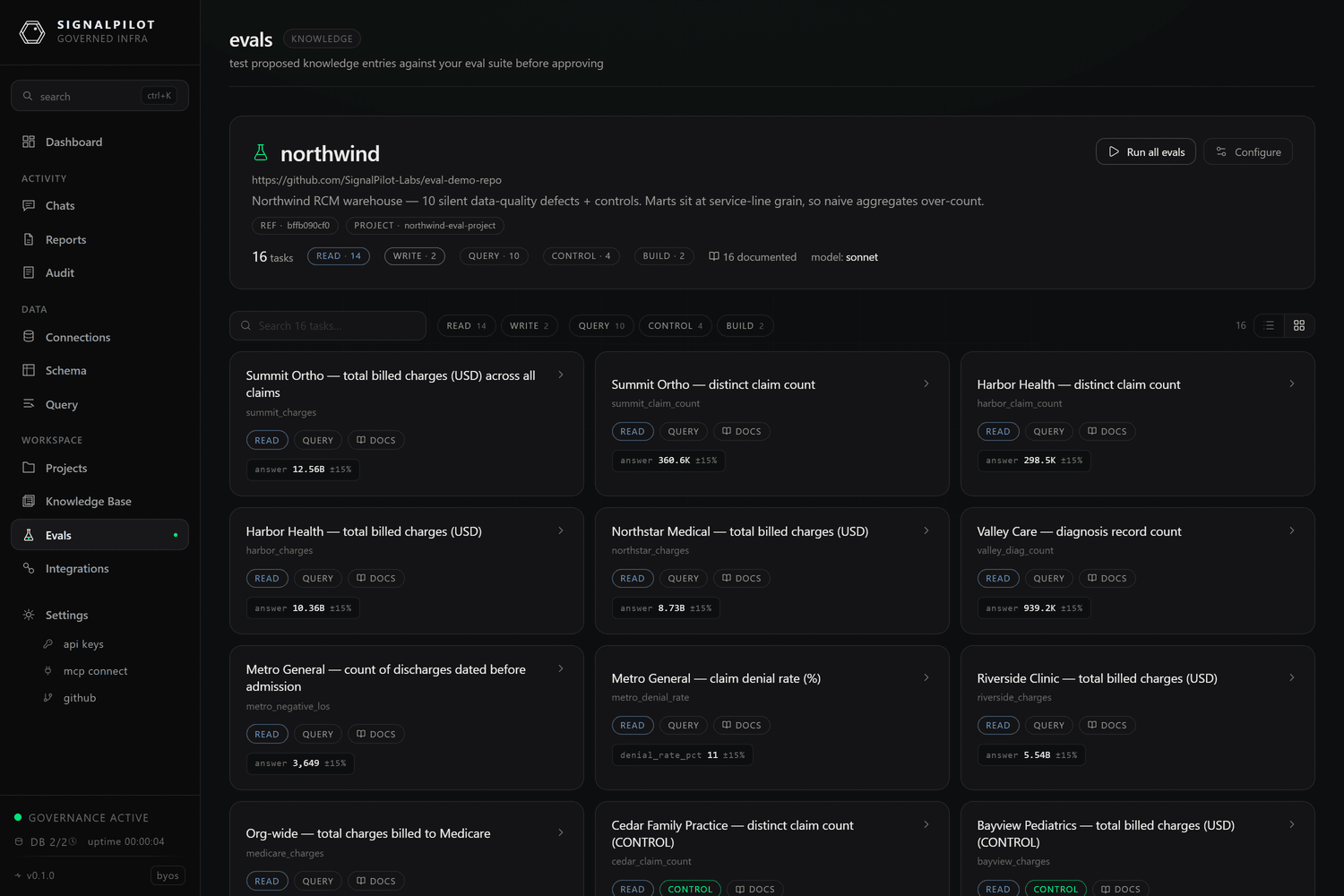
An eval is a graded question you already know the answer to. SignalPilot runs each one as a real agent against your real warehouse, in a sandbox, and scores what comes back.
That gives you a number for something that is otherwise a matter of opinion: is the agent getting our data right, and did that change last week make it better or worse?
Why this exists
A data agent can be wrong in ways that look right. It reads a mart that fans out and reports a total 6× too large; it picks the stale copy of a table; it answers confidently from a column that means something else. None of that shows up as an error — it shows up as a number in a deck.
Evals close that loop:
- Regression testing for knowledge. Every knowledge-base entry you approve changes how the agent reasons. A run before and after tells you whether it helped.
- Grading the agent, not the SQL. Tasks are phrased the way a person would ask. The agent chooses its own approach; the grade is on the answer.
- Evidence, not vibes. Every run keeps the full transcript, the tables the agent built, and the coverage it touched.
How a run works
eval repo (git)            your warehouse
     │                           │
     ▼                           ▼
 gateway clones          pinned connection ──┐
 the manifest                               │
     │                                      │
     ├── read task  ──► sandbox ── MCP ──────┤ shared build branch (read-only)
     │                     │                 │
     └── write task ──► sandbox ── DSN ──► disposable branch (forked, then destroyed)
                           │
                           ▼
                  transcript · captures · verdict
                           │
                           ▼
                    S3 / MinIO evidence
- Fetch. The gateway clones your eval repo and parses
eval.json. - Ship the project. If the manifest names a
project_repo, the gateway clones that dbt project, strips.git, and hands each sandbox a short-lived presigned tarball. The sandbox never gets a git credential. - Fan out. Tasks run concurrently, up to the configured parallelism. Each one is a short-lived container (Docker locally, a Kubernetes pod in cloud) running the Claude CLI against the SignalPilot MCP server.
- Isolate. Read tasks share one read-only view of the warehouse through the pinned connection. Write tasks each fork their own disposable branch.
- Grade. Numeric answers are matched against the manifest's checks; rebuilt models are inspected on the branch.
- Keep the evidence. Transcripts, setup logs, and table captures go to the evidence store. Branches and temporary connections are destroyed.
Verdicts
| Verdict | Meaning |
|---|---|
CORRECT | Every check passed. |
PARTIAL | Some checks passed, some did not. |
OFF | A number was found, and it was wrong. |
UNKNOWN | No number could be extracted from the answer. |
UNGRADED | The task declares no checks. |
ERROR | The container failed, or the task blew a quota. |
SETUP_FAILED | The task's setup script exited non-zero; the agent never ran. |
Accuracy is CORRECT / (total − UNGRADED).
One subtlety: a container that hits its timeout is only ERROR if it produced
no answer. If a truncated transcript still contains a number, that number is
graded like any other — so a task can time out and still score CORRECT. Check
task durations against SP_EVAL_TIMEOUT_SECONDS when a result looks surprising.
Read tasks and write tasks
| Read task | Write task | |
|---|---|---|
| Warehouse access | Governed MCP only (read-only) | MCP plus a branch DSN for writes |
| Isolation | Shared build branch | Its own forked branch, destroyed at the end |
| Setup / teardown scripts | Not allowed | Allowed |
| Graded on | The number in the answer | The number, or the model it rebuilt |
| Cost | One container | One container plus a branch fork |
Read tasks are the default and cover most questions. Write tasks exist for the harder question: can the agent rebuild this mart correctly when it is gone?
Where to go next
- Quickstart — point SignalPilot at the public demo eval set and get a graded run.
- Eval repo format — every field in
eval.json. - Write tasks and branches — setup scripts, forked
branches,
model_rebuiltgrading, table captures. - Running and reading results — verdicts, coverage, transcripts, exports, regression alerts.
- Deploying the harness — everything an operator must configure, in cloud and self-hosted.