Schema explorer
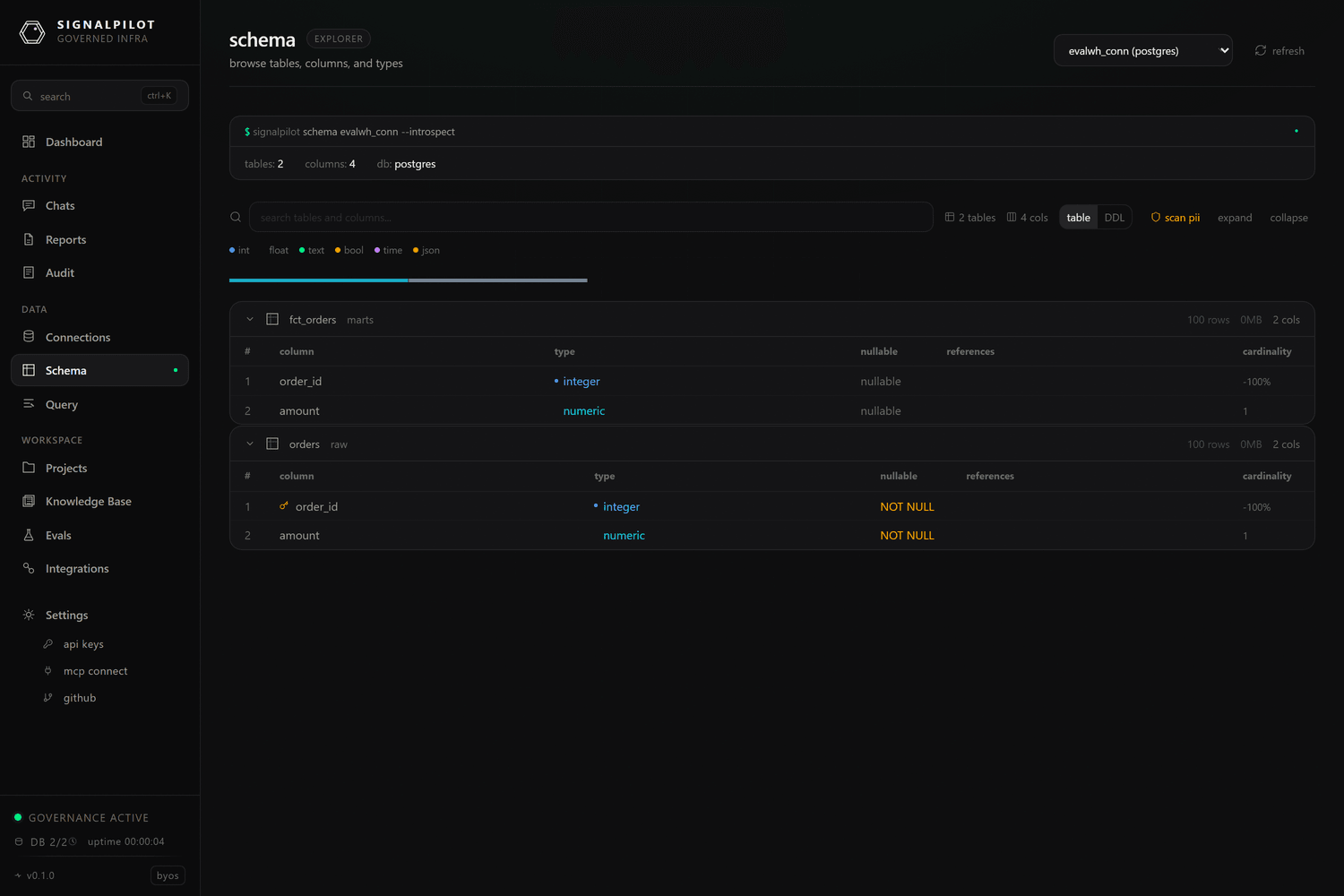
Schema is the human view of what the agent sees: every table in a connection, its columns, types, nullability, keys, and comments — plus the governance annotations layered on top.
Pick a connection, then search across tables and column names to find the one you mean. Selecting a table shows:
- Columns — name, type, nullability, primary and foreign keys, and any comment carried from the warehouse.
- Cardinality — distinct-value counts where the connector supports them.
- References — outgoing foreign keys, so you can walk a join path by hand.
- CREATE TABLE DDL — the reconstructed DDL, copyable.
The schema is cached; re-scanning refreshes it. The same cache backs the agent's
list_tables, describe_table, and schema_overview tools, so what you see
here is what it sees.
PII scan
Scan PII runs a name-based detector across every cached column and reports what it thinks is sensitive, per table, with a suggested rule:
| Rule | Effect when applied |
|---|---|
hash | Values are replaced with a stable hash in query results |
hide | Values are replaced with a redaction marker |
The scan is a proposal, not an enforcement — it detects, it does not change behaviour on its own. Detection is available on every plan; enforced redaction on query results is a paid feature (see plan limits).
The scan matches on column names, so it finds email, ssn, phone_number, and
misses a sensitive column called field_7. Treat it as a first pass over a
schema you do not know, then encode the real answer in annotations.
Annotations: blocking tables and marking columns
Per-connection annotations are the governance layer under the explorer. Two things they control:
- Blocked tables. A blocked table is refused at query time — for you, for the agent, for everything going through the gateway. This is how you keep a payroll table out of reach without changing warehouse grants.
- PII columns. A column marked
hashorhideis transformed in results, again for every caller.
Annotations live per connection and are cached with a TTL of
SP_ANNOTATIONS_TTL (60 seconds by default), so a change takes effect within a
minute without a restart.
Related
- Governance — the full rule set applied to every query.
- Schema tools — the MCP equivalents of this
page, including
schema_difffor detecting drift between scans. - Connection health — latency and error rates per connection.